-
Address: 16/9, Scotland United Kingdom
-
Email: fodgesol@example.com
-
Phone: +1 16355 65389


Blog
AI vs Traditional
Software: What’s Changing?
AI vs Traditional Software: What's Changing?
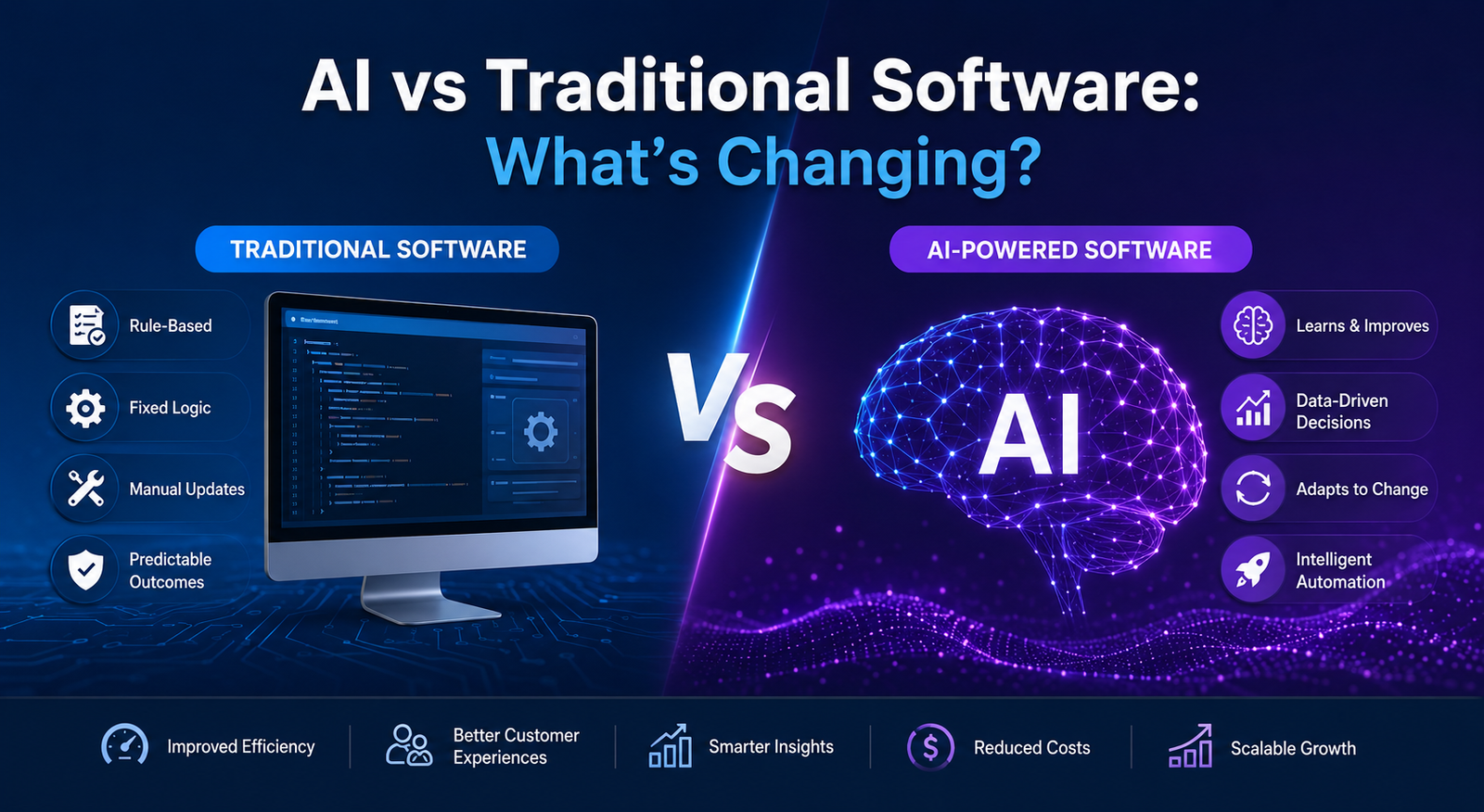
For decades, software was built on a simple premise: a developer writes explicit rules, and the program follows them exactly. If a customer's order met certain conditions, the system processed it one way. If not, it did something else. Every outcome was predictable because every outcome was pre-programmed. Artificial intelligence is rewriting that premise. Instead of following fixed rules, AI-powered systems learn patterns from data, make predictions, and improve their performance over time. For businesses, this is not just a technical upgrade it is a fundamental shift in what software can do, how it is built, and how much value it can create. At Bugnatics, we work with businesses every day that are trying to understand where traditional software ends and AI-driven systems begin and more importantly, where the line should be for their specific operations. Here is what is actually changing, and what it means for your business.
How Traditional Software Works Traditional software operates on deterministic logic. A developer maps out every possible scenario in advance using conditional statements: if this happens, do that. This approach has powered businesses successfully for decades, and it remains the right choice for many applications. Traditional software excels at:
Processing transactions with fixed, well-defined rules
Managing structured data such as inventory records or financial ledgers
Executing repetitive tasks that follow the same steps every time
Delivering predictable, auditable outcomes required for compliance
How AI-Powered Software Works
AI-driven systems take a different approach entirely. Rather than being told exactly what to do in every situation, they are trained on data and learn to recognize patterns, make predictions, and generate responses based on what they have learned.
This shift unlocks capabilities that were previously impossible or prohibitively expensive to build: Systems that improve their accuracy over time as they process more data Software that can interpret unstructured data such as images, text, and voice Tools that make predictions about future behavior rather than just reporting on the past Interfaces that understand natural language instead of requiring rigid commands The strength of AI is adaptability. The trade-off is that AI systems are probabilistic rather than deterministic they produce the most likely correct answer, not a guaranteed one. This makes governance, testing, and monitoring more important than ever.
Key Areas Where the Shift Is Happening
Customer Support
Traditional systems relied on static FAQ pages and rule-based chatbots that could only follow scripted decision trees. AI-powered support tools now understand context, interpret intent, and resolve a far wider range of customer queries without human intervention while escalating genuinely complex issues to the right person automatically.
Data Analysis and Forecasting
Traditional reporting tools summarize what already happened last month's sales, last quarter's churn rate. AI-driven analytics go further, identifying patterns in historical data to predict what is likely to happen next, whether that is demand for a product, the likelihood of customer churn, or potential supply chain disruptions.
Process Automation
Traditional automation could only handle tasks with rigid, predictable inputs. AI-enhanced automation can now process varied, unstructured inputs — a scanned invoice, a handwritten form, an email with an attached document and route, extract, and act on that information without a human needing to standardize it first.
Personalization
Traditional e-commerce and content platforms offered the same experience to every user, perhaps with basic segmentation. AI-driven personalization engines now tailor product recommendations, content, pricing, and messaging to each individual user in real time, based on their behavior.
Search and Discovery
Traditional search relied on exact keyword matching. AI-powered search understands intent and context, returning relevant results even when a query does not match the exact wording in a database a capability that is transforming everything from internal knowledge bases to customer-facing product search.
How Bugnatics Approaches AI Integration
At Bugnatics, we do not believe in AI for the sake of AI. Every AI solution we build starts with a clear business problem: a process that is too slow, a decision that lacks data support, a customer experience that feels generic, or an operation that does not scale with your growth.
From there, we design AI capabilities that integrate directly into your existing software environment whether that is your CRM, your e-commerce platform, your internal tools, or a custom system we build from the ground up. We combine the reliability of traditional software architecture with the adaptability of AI where it genuinely adds value, giving you a system that is both dependable and intelligent.
If you are wondering where AI fits into your business or whether your current systems are holding you back our team is ready to help you find out.
Looking to explore how AI can strengthen your business systems? Get in touch with Bugnatics to discuss your project.